1X from Moss: The robot moving into your home
Bernt Børnich founded 1X Technologies in Moss, Norway. Now he builds humanoid home robots for 20,000 dollars. First deliveries in 2026.
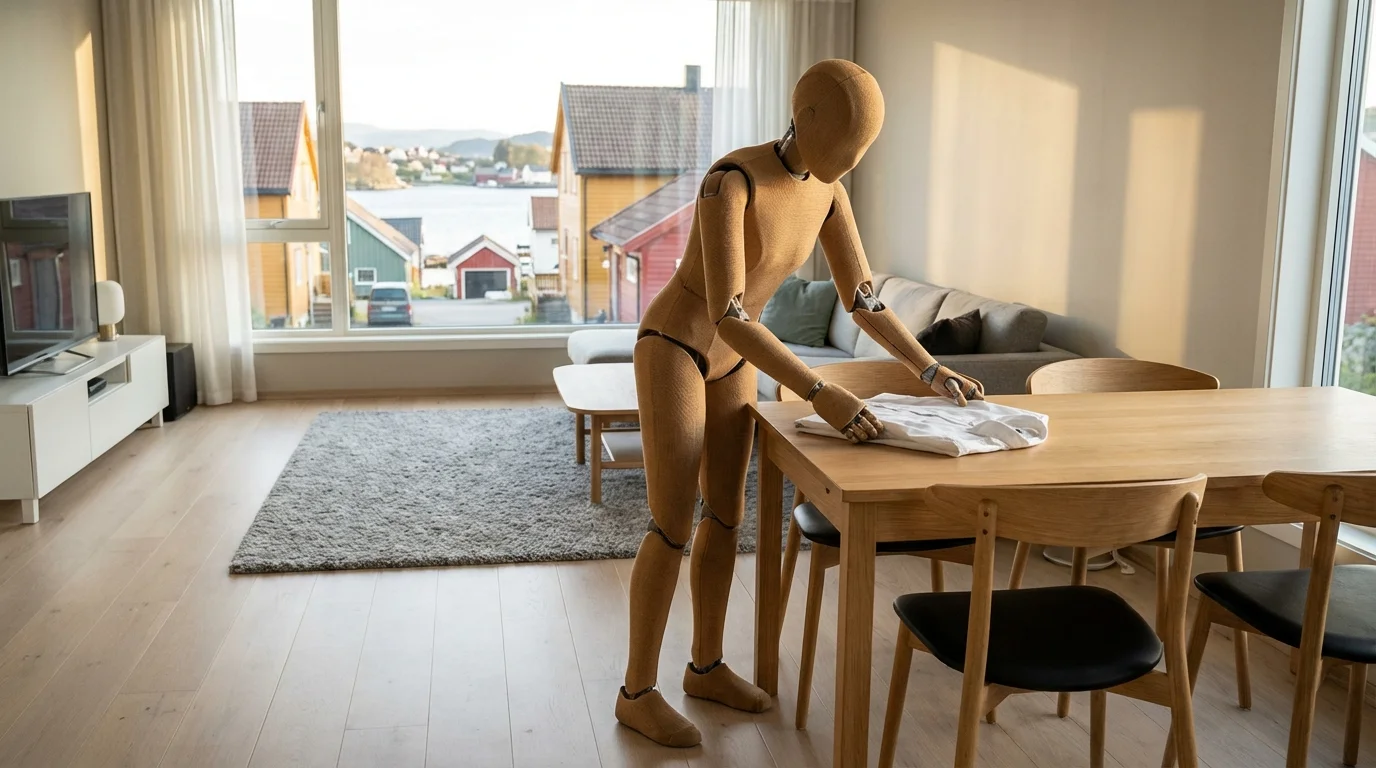

It started with a boy in Moss, Norway, who took apart everything he could get his hands on. Now he builds robots designed to live in your home.
As a fellow "mossekråke" (the local nickname for people from Moss), it is hard not to feel proud of what Bernt Børnich has achieved. A kid from a small Norwegian industrial town who took an idea from a garage in Østfold to the world's biggest investors, and who still builds his robots here. Not in Shanghai. Not in Detroit. In Moss. That says something about what is possible when you refuse to move your dream to a different zip code.
Bernt Øivind Børnich founded Halodi Robotics in 2014. A small company in a small Norwegian town with an absurd ambition: building humanoid robots that can safely coexist with people. Ten years later, the company is called 1X Technologies, valued at over 10 billion dollars, with OpenAI, Samsung, and Tiger Global as investors.
The factory is still in Moss.
The robot is called NEO. It stands 168 centimeters tall, weighs 30 kilograms, and is wrapped in a soft 3D-knitted nylon shell that makes it safe to touch. Under the skin: tendon-driven joints, a composite frame, and hands with 22 degrees of freedom each. Human-level finger dexterity. Four-hour battery life.
NEO does housework. Vacuuming, tidying, carrying laundry, watering plants, taking out the trash, answering the door. You give it a list of chores, set a schedule, and come home to a cleaner house. Tasks it cannot handle yet are learned through remote guidance from a 1X expert wearing a VR headset, and it gets better every time.
The price is 20,000 dollars. Pre-orders are open. First deliveries to American homes happen in 2026, the rest of the world in 2027.
Take a moment to consider what that means.
A humanoid home robot costs about the same as a used car. It requires no salary, no vacation, no sick leave. It works four hours at a time, charges itself, and gets smarter over time. Version 1.0 needs help with complex tasks. Version 3.0 probably will not.
Børnich said it himself in a Wall Street Journal interview: 2025 is about scaling. 2026 is about gathering enough data from early adopters to make the systems genuinely useful. That means the first customers are teachers as much as buyers. Every time NEO tries and fails, it gets a little better. Not just for you, but for everyone who owns one.
The path from Moss to Silicon Valley was short for Børnich. He was talking to Sam Altman about connecting AI to robotics long before ChatGPT existed. OpenAI led the Series A2 in March 2023. In January 2024, 100 million dollars came in through Series B. By September 2025, they were seeking another billion, with a valuation that had multiplied twelvefold in under two years.
In January 2026, they launched NEO Gamma, an updated version with even more natural walking, better object handling, and a design that lets it wear regular clothes. Mashable described it as the most huggable humanoid robot ever made.
Behind the numbers and the technology lies a simple insight: the home is the last place robots have reached. Factories have had them for decades. Warehouses have them. Hospitals are starting to use them. But the home is messy, unpredictable, full of things that fall over, children running around, and dogs begging for food. It requires a different kind of robot.
1X is building that kind. From Moss, Norway. And those of us who grew up there are smiling a little wider because of it.
But today's NEO is a calculator watch compared to what is coming.
The combination of humanoid robots and artificial general intelligence, AGI, is what changes absolutely everything. Not just housework. Everything.
Imagine NEO with a brain that understands the world as well as a human. That sees what you need before you say it. That learns new tasks in minutes, not months.
In manufacturing, it does not just replace the arms on the assembly line. It understands the entire process, spots defects, optimizes flow, switches between tasks without reprogramming. A factory full of NEOs coordinating with each other, around the clock, without breaks.
In healthcare, it becomes the nurse who is never tired. Lifting patients, dosing medicine, monitoring vital signs, alerting the doctor. In nursing homes, it sits with residents, remembers the names of their grandchildren, reads aloud, reminds them about the pills at eight o'clock.
At the hair salon, it cuts your hair better than most humans, because it has seen a million haircuts and remembers exactly what you liked last time. No bad days, no shaking hands, perfect symmetry every time.
As a cleaning service, it does the entire house while you sleep. Not just the vacuum in straight lines. It sees the stains on the kitchen counter, does the windows, folds the clothes, tidies the kids' rooms, and puts things back where they belong.
As a personal shopper, it knows your wardrobe, understands what fits your body, follows trends, and shops for you. When the package arrives, it hangs the clothes in your closet.
And it travels with you. On vacation, it carries the luggage, checks in, finds the restaurants, takes the photos, keeps track of tickets and passports. Not like a suitcase with wheels, but like a travel companion who is never tired and never loses the boarding pass.
This is no longer science fiction. 1X is building the body. OpenAI is building the brain. The question is not whether it happens, but how fast. Børnich himself estimates that NEO will handle most tasks autonomously by 2026. Add AGI-level intelligence within the next three to five years, and you have a machine that can do everything a human can physically, with a brain that never forgets and never stops learning.
The most radical consequence might be the simplest. You get your time back. All the time you spend cleaning, shopping, tidying, carrying, waiting, searching. That time is yours again.
And it costs 20,000 dollars.
Watch NEO in action: https://www.youtube.com/watch?v=LTYMWadOW7c