Alibaba launches Zhenwu M890 as China builds AI chips for agents
Alibaba’s Zhenwu M890 and Panjiu AL128 push agent workloads into domestic AI infrastructure. For leaders, the issue is capacity, export controls and lock-in.

BEIJING/SINGAPORE: Alibaba is turning AI chips into a board-level infrastructure issue, not just a data-centre component.
The company on Wednesday unveiled Zhenwu M890, a new AI processor from its chip design subsidiary T-Head. Reuters reports that Alibaba says the chip delivers three times the performance of the previous Zhenwu 810E and is built for agentic workloads: systems that keep long context, coordinate models and carry out multi-step tasks with less human supervision.
That is the point executives should not miss. AI infrastructure is being redesigned for a different kind of usage than classic chatbot traffic. When agents code, analyse, retrieve data, use tools and run for long chains of work, memory, networking and accelerator-to-accelerator communication matter as much as raw compute.
Alibaba is positioning M890 directly in that fight. The company also set out a multi-year chip roadmap: V900 in the third quarter of 2027 and J900 in the third quarter of 2028. Alibaba says V900 should deliver roughly three times the performance of M890. This is not a one-off launch. It is an attempt to create a Chinese cadence for AI silicon.
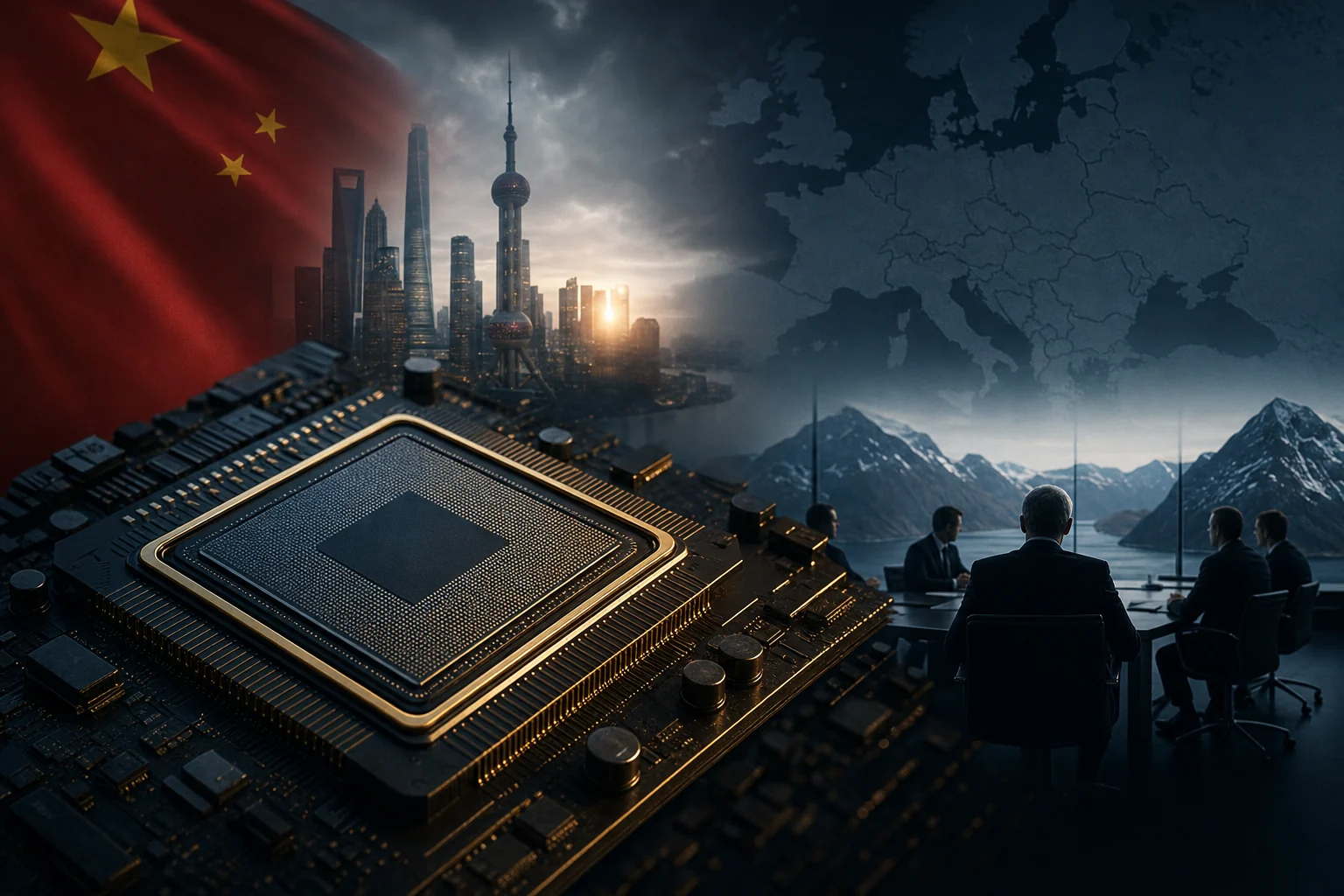
The background is simple and hard: the United States is tightening exports of the most powerful Nvidia processors to Chinese customers. China is responding with domestic chips, domestic model platforms and domestic server architectures. Huawei has already become the clearest national Nvidia alternative. Alibaba is now trying to move the same logic into its own cloud, models and enterprise customer base.
What Alibaba actually launched
Reuters says M890 was unveiled at Alibaba Cloud Summit. The chip was developed by T-Head and is designed for the heavy memory and communication demands of agent workloads. Alibaba also introduced Panjiu AL128, a server system that packages 128 accelerators into a single rack-level system.
The system is immediately available to Chinese enterprise customers through Alibaba Cloud's domestic model platform, Bailian. That matters. This is not just a laboratory benchmark story. Alibaba is trying to bind chip, server, cloud platform and model use into one commercial package.
T-Head says it has shipped more than 560,000 Zhenwu units so far, with more than 400 external customers across 20 industries using the chips. Reuters mentions automotive and financial services among the sectors. Those are Alibaba numbers, not independent benchmarks, but they show the ambition: this is meant for production, not a conference booth.
Alibaba also connected the launch to Qwen 3.7-Max, the latest version of its flagship large language model. The company says the model is engineered for advanced coding and long-running agent tasks and can operate continuously for up to 35 hours without performance degradation. That claim should be treated carefully until independent testing exists. But the direction is clear: model, agent and chip are being optimised together.
Why this matters outside China
For Norwegian and European companies, the main question is not whether Alibaba Cloud becomes the default platform tomorrow. For many organisations the answer will be no, because of regulation, security and geopolitical risk. The larger point is that the AI market is splitting faster into regional technology stacks.
On one side sit Nvidia, OpenAI, Microsoft, Google, AWS and western cloud platforms. On the other, Chinese players are building more integrated packages with their own models, chips and clouds. Between them are European organisations that need capacity, data control, lower lock-in and faster progress on agent projects.
This changes procurement. A CIO can no longer assess an AI platform as software alone. The questions are physical: which accelerators is the platform optimised for? Where is the capacity located? What happens if export rules, supplier prioritisation or geopolitics change price and availability? Can the workload move, or is it tied to one model, one API, one cloud and one chip family?
It is also a CFO issue. Alibaba said last year it would spend more than 380 billion yuan, around $53 billion, on cloud and AI infrastructure over three years. That level of capital spending shows how expensive the agent race is becoming. When vendors bind models more tightly to their own hardware, pricing becomes less transparent. A cheap API can still be expensive if it locks the company into the infrastructure.
Agents make chip strategy more strategic
The traditional AI debate has focused heavily on model quality. Which model scores best? Which is cheapest per token? Which writes better code? Agentic systems move part of the competition lower in the stack.
An agent that runs for hours rather than seconds stresses infrastructure differently. It needs long context windows, tool calls, memory, fast data movement and stable execution. It can use several models at the same time. It can also create unpredictable demand: a simple user request may turn into hundreds of backend operations.
That is why M890 is interesting even before Alibaba has proven every performance claim in public. It shows that chip vendors are now designing explicitly for agent patterns. The same logic is visible in western infrastructure stories: compute is sold as scarce capacity, new CPU/GPU combinations are built for agent traffic, and cloud providers are building control planes for tools, logging and approval.
For boards, AI risk is no longer only about hallucinations and data leakage. It is also about capacity access, supplier power and how quickly competitors in other regions can industrialise AI workflows.
What leaders should do now
The first step is to map where agent projects actually run. Not just the vendor name, but model, cloud region, accelerator dependency, data sources, tool access and exit options. If the workflow only works inside one vendor's full stack, that should be an explicit decision, not an accident of implementation.
The second step is to tighten contracts. Ask for capacity terms, price protection, data location, model-change notice, logging, auditability and what happens under export controls or supplier restrictions. This matters especially for finance, industry, energy, public sector organisations and companies operating across the US, Europe and Asia.
The third step is to separate pilots from production. An agent demo can be cheap and simple. A production agent that runs for long periods, uses tools and touches money, customers or critical operations is an infrastructure decision. It needs budget, architecture and governance like an operationally critical system.
Alibaba's launch is not a recommendation to buy Alibaba Cloud. It is a signal about where the AI market is heading: more vertical stacks, more regional technology and more physical scarcity. Leaders who still treat AI as "just software" will negotiate too late.
Sources and media
- Primary source: Reuters, “Alibaba unveils new AI chip in push for domestic alternatives”, published 20 May 2026: https://www.reuters.com/world/asia-pacific/alibaba-unveils-new-ai-chip-push-domestic-alternatives-2026-05-20/
- Reuters credit: this article is based on Reuters reporting from Beijing/Singapore, including Alibaba's statements about Zhenwu M890, Panjiu AL128, T-Head shipments, Qwen 3.7-Max and the company's multi-year chip roadmap.
- Background: Alibaba Cloud Community, “In-depth Analysis of Alibaba Cloud Panjiu AL128 Supernode AI Servers and Their Interconnect Architecture”, 14 November 2025: https://www.alibabacloud.com/blog/in-depth-analysis-of-alibaba-cloud-panjiu-al128-supernode-ai-servers-and-their-interconnect-architecture_602665
- Image use: Reuters news photography is not rehosted. Thumbnail: OpenAI Image 2 / hogby.ai.