Anduril and Meta want AI glasses that can steer drones in combat
MIT Technology Review describes Anduril and Meta’s military AI glasses. For executives, the issue is agent control, authority and accountability.
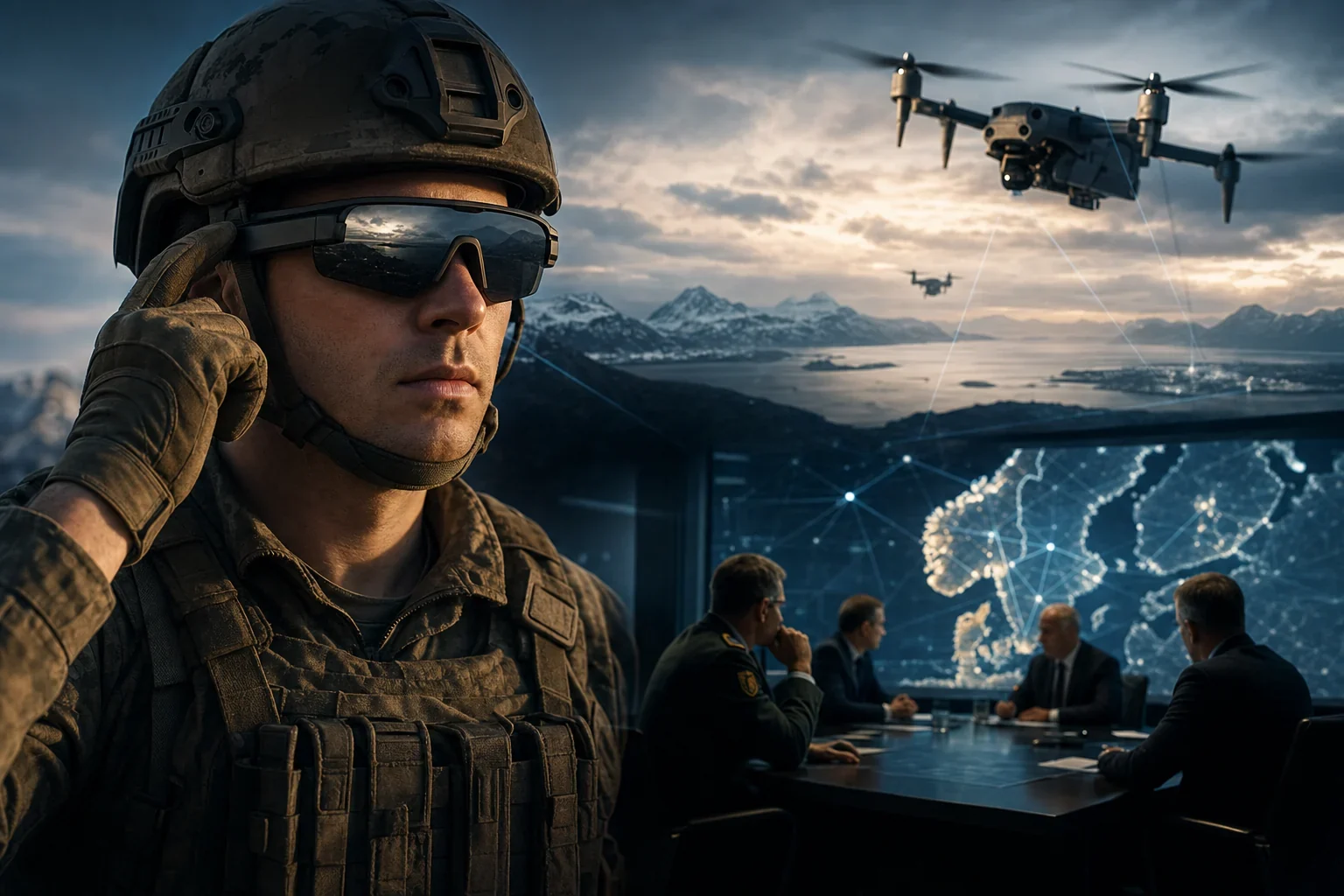

MIT Technology Review has new details on Anduril and Meta’s work on military AI glasses for the US Army. The ambition is not just better night vision. The goal is an interface where soldiers can see drones, targets, maps and orders in the same field of view, and where large language models translate speech, gaze and small gestures into commands software can execute.
That marks a clear shift in what AI systems are being positioned to do. From analysis and support in a control room to action-adjacent decisions in the field. Anduril describes the aim as turning the soldier into a more connected node on the battlefield. MIT Technology Review quotes Anduril executive Quay Barnett saying he wants to optimize “the human as a weapons system.” That wording should make defense leaders, suppliers and boards read slowly.
Anduril has two parallel tracks. The first is Soldier Borne Mission Command, SBMC, where the company received a $159 million prototyping contract in 2025. Anduril is working with Meta and other partners on mixed-reality glasses that can attach to existing military helmets. The second is EagleEye, Anduril’s self-funded helmet and visor system, where AI, sensors, digital night vision and command software are built more tightly into the equipment.
According to MIT Technology Review, the systems are still years away from broad deployment. The Army is not expected to pick a production candidate before 2028 at the earliest, if it picks one at all. Microsoft’s earlier IVAS effort is the warning label. A planned $22 billion production contract was cancelled after the glasses failed to prove viable. The technology has to handle dust, smoke, explosions, poor connectivity, local AI execution, weight limits and soldiers who are already carrying too much.
Still, the direction matters. MIT describes a scenario where a soldier asks a drone to monitor an area, lets the system look for something resembling artillery, and then receives recommended courses of action. A strike would still require approval through the normal chain of command. But the interface moves AI closer to fire control, drone tasking and real-time judgement. This is no longer just a dashboard. It is an agent in the decision loop.
Anduril is testing large language models including Google’s Gemini, Meta’s Llama and Anthropic’s Claude, according to MIT, to turn a soldier’s instructions into operational commands. The core engine is Anduril’s Lattice software, which fuses data from military sensors and systems. In March, DefenseScoop reported that the Army announced a $20 billion agreement to integrate Lattice broadly into its infrastructure.
For Norwegian and European executives, the point is not that an American soldier may get smarter glasses. The point is that AI agents are moving from screens to action. When the same pattern reaches industry, energy, healthcare, emergency response and finance, the key question is not whether the model is impressive. The question is who has authority, what is logged, when a human must approve, and how errors are rolled back.
The defense context makes the dilemma sharper. A system that identifies objects, proposes drone use and filters information for a stressed operator may reduce chaos. It may also create new failures. A bad classification, an unclear approval chain or an interface that consumes too much attention can have consequences far beyond a normal IT incident. RAND researcher Jonathan Wong warns in the MIT story that soldiers will reject systems that consume more mental bandwidth than they save. The boardroom version is simple: technology that increases speed without clarifying responsibility increases risk.
This is therefore a governance story, not a gadget story. NATO countries and European defense suppliers must deal with US platforms, US AI models and US supply chains. Anduril says the components must be built without reliance on Chinese companies. That points to a broader reality: AI infrastructure, sensors and defense technology are becoming the same supplier-risk conversation.
Three questions should be asked before systems like this get close to operations. First: which actions may the AI agent suggest, and which may it execute on its own? Second: who owns the decision log when several models, sensors and suppliers are inside the same loop? Third: what happens when the model, the network or the operator is wrong under pressure?
Anduril and Meta show where the AI interface is going. It is becoming more physical, more operational and more connected to real-world actions. An AI policy in a folder will not be enough. Leaders need concrete authority rules, test regimes, supplier requirements and kill switches before agents are allowed to carry responsibility in production.
Sources and media
- Primary source: MIT Technology Review, “Inside Anduril and Meta’s quest to make smart glasses for warfare”, published May 18, 2026: https://www.technologyreview.com/2026/05/18/1137412/inside-anduril-and-metas-quest-to-make-smart-glasses-for-warfare/
- Background: Anduril, “Anduril Awarded Contract to Redefine the Future of Mixed Reality”, September 8, 2025: https://www.anduril.com/news/anduril-awarded-contract-to-redefine-the-future-of-mixed-reality
- Background: Anduril, “Anduril’s EagleEye Puts Mission Command and AI Directly into the Warfighter’s Helmet”, October 13, 2025: https://www.anduril.com/news/anduril-s-eagleeye-puts-mission-command-and-ai-directly-into-the-warfighter-s-helmet
- MIT Technology Review uses an Anduril image in the story. hogby.ai does not rehost the source image.
- Thumbnail: OpenAI Image 2 / hogby.ai.