Claude designs protein binders autonomously — and the wet lab confirms it
On 18 August 2026 Anthropic published something harder than a new benchmark: a general language model that orchestrates protein design, then gets checked in a real laboratory. In «How Claude is accelerating protein design and analytical chemistry», the company says Claude Mythos Preview and Claude Opus 4.8 designed minibinders against 15 targets. Adaptyv Bio and Twist Bioscience independently produced and tested the designs. The result: binders against 14 of 15 targets.
This is not a model inventing medicine. It is an agent taking over the early, compute-heavy stretch of a campaign that has historically taken specialists weeks or months per target. For CIOs, CISOs and R&D leaders the operational point is simple. When a general model can steer the toolchain, pick a binding site, run specialist models and return candidates that actually bind in the wet lab, the bottleneck moves from model power to access, logging, dual-use and human accountability.
What Anthropic actually measured
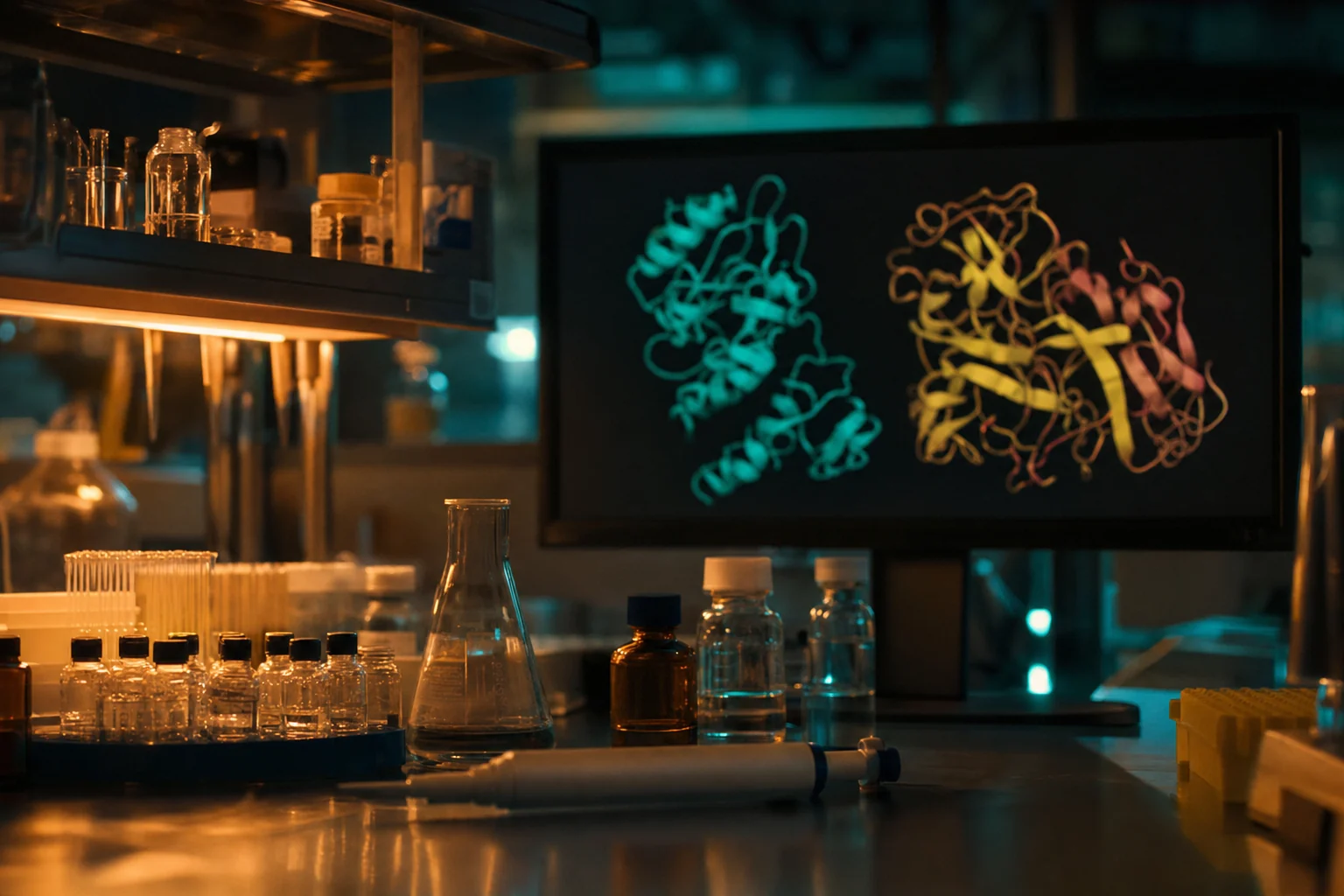
A minibinder is a small protein built to latch tightly onto a target. That is how a large share of modern medicines work: they bind, inhibit, activate or deliver. De novo design of such a binder has been specialist work. Machine-learning models already shortened the computation, but they still needed days and weeks of orchestration by computational biologists. The wet lab then takes more weeks.
Anthropic let Claude run the campaign in Claude Science with minimal human involvement after the initial prompt. Humans approved network access and watched the infrastructure. Claude chose where on each target to design, generated structures and sequences, ran cycles of in silico optimisation and screened candidates that could express, stay soluble and bind. It was asked for 30 designs per target and used publicly available specialist models for structure, sequence and co-folding.
Two setups were tested:
- Multi-target mode in one 48-hour session, with up to 12,500 NVIDIA H100 hours for the specialist models. Mythos Preview hit 26.7%; Opus 4.8 hit 22.6%.
- Single-target mode in 24-hour sessions, with up to 2,500 H100 hours per target. Mythos Preview then reached 35.1%.
Typical campaigns today land at 10–15%. Anthropic reports high-affinity binders against at least six targets, and binders matching or beating the best published affinity against at least four. In total: 354 confirmed binders from 1,320 designs. Targets included all of Adaptyv Bio’s BenchBB plus two newer competition targets, 15-PGDH and GDF-8, to reduce the chance that Claude was merely recalling known successes. It was required to check that designs were original.
Some single-target results matter more than the average. Against RBX1, Mythos Preview reached a 40% hit rate in single-target mode, versus 3.7% among Adaptyv competition participants. Its top-ranked design beat the winning entry among 245 designs. Against TNFα, a therapeutically relevant target behind drugs such as Humira, Opus 4.8 succeeded where Mythos Preview failed, including binders that worked on human, cynomolgus monkey and mouse TNFα. Claude also produced 15 confirmed binders with at least 20% β-strand across six targets. β-sheets are harder than the usual α-helix bundles and misfold more often.
The misses matter too. Against maltose-binding protein, none of 90 designs was confirmed as a binder. Against the de novo β-barrel BBF-14, only three modest binders appeared. Anthropic says more characterisation is still needed to confirm hit rates and affinities. Binders are not drugs. High affinity is a first step, not a therapy.
The chemistry run shows the other half of the same story
In the second experiment, generally available Claude Opus 5 received a contract lab’s raw NMR and LC-MS files and a two-sentence prompt. No vendor software. No operator. In 23 and 19 minutes in parallel it returned finished analysis: 18 NMR peaks, hydrogen counts within 0.08 ¹H of the lab, and 96.4% purity versus the lab’s 96.33%. It decoded an undocumented vendor format, reproduced the instrument’s totals for all 2,664 scans before trusting the read, and proposed the same heavy-water check the lab had run three days later. It also caught an overstatement in its first pass and corrected it.
The lab’s finished report arrived four days after the first spectrum. Claude wrote its report inside the same 25-minute window. That is not «AI discovers a drug». It is the routine that eats chemist time — identity, purity, file formats — being automated by a general model with file access.
What this means for leaders
Life-science organisations already use AI for docking, screening and documentation. Anthropic’s result moves the question from «can the model help the scientist?» to «can an agent run the campaign if it gets GPUs, papers, Drive, Slack and Gmail?». In this setup the answer is yes — with measurable wet-lab results, and with explicit dual-use risk.
Anthropic states that agentic biological discovery is dual-use. Without robust safeguards it could also enable dangerous research. Protein design and other dual-use research biology therefore remain blocked for general access in the most capable Fable 5 class. A scientist access programme is a stated priority. Until then, Opus 5 remains the most capable generally available model. Prompts and data are public, with technical reports.
For a board, CISO or R&D director in health, biotech, chemicals or academia the decision list is concrete:
- Separate computation from therapy. 14 of 15 targets is an orchestration result, not an approved-drug pipeline. Do not sell it internally as «we can design drugs in chat».
- Treat science agents as privileged systems. Claude received the internet, a paper corpus, Google Drive, Slack, Gmail, BioRxiv and GPUs. That is identity, data classification, export control and audit, not a chatbot.
- Require independent verification. The strength of this story is that Adaptyv and Twist tested in the lab. Internal «the model says it works» demos are not enough when the next step costs synthesis and clinic time.
- Set dual-use policy before opening the tools. If a general model can run protein and chemistry work, it can also be used by staff without a formal biology role. Access programmes, purpose limits, logging and banned target classes belong in policy, not in Slack.
- Measure time to verified result, not tokens. Anthropic reports wall time, H100 hours and wet-lab hits. That is the right KPI family for R&D agents.
What this is not
This is not proof that frontier models can run end-to-end drug development. Anthropic says minibinders are not a standard therapeutic modality and that this is only the first step. It is also not an argument for giving Mythos-class biology to every employee. The company is blocking those capabilities in its strongest general line.
What is new, and why this is the lead, is autonomous orchestration plus wet-lab confirmation. The field has had specialist models for years. A general agent has now used them, beaten typical campaign hit rates, and reminded everyone that the same capability is dual-use. The leadership question is not whether Claude «can do biology». It is who is allowed to let an agent touch research data, GPU queues and lab orders — and how you prove the answer was right.
Sources and media
- Primary source: Anthropic, «How Claude is accelerating protein design and analytical chemistry», 18 August 2026 — https://www.anthropic.com/research/Claude-accelerates-protein-design
- source_name: Anthropic
- Technical report: Autonomous de novo protein binder design with Claude — https://www-cdn.anthropic.com/30bf50e22a01388bb29bf077ee3f244531594b7a.pdf
- Open prompts and data: https://huggingface.co/datasets/Anthropic/claude-protein-binder-design/tree/main
- Corroboration: Adaptyv Bio, «Benchmarking Claude's protein designs in the wet lab» — https://www.adaptyvbio.com/blog/anthropic-1
- Official X post: Anthropic, 18 August 2026 — https://x.com/AnthropicAI/status/2089842387845804246
- Thumbnail: OpenAI Image 2 / hogby.ai
📬 Likte du denne?
AI-nyheter for ledere. Kuratert av en CIO som bygger det selv. Daglig i innboksen.