Google's new robot model packed car parts at Mercedes-Benz – with a 96 percent success rate
Google DeepMind launches Gemini Robotics 2.5. A humanoid robot picked and sorted car parts at two Mercedes-Benz plants with a 96 percent success rate, according to the company.
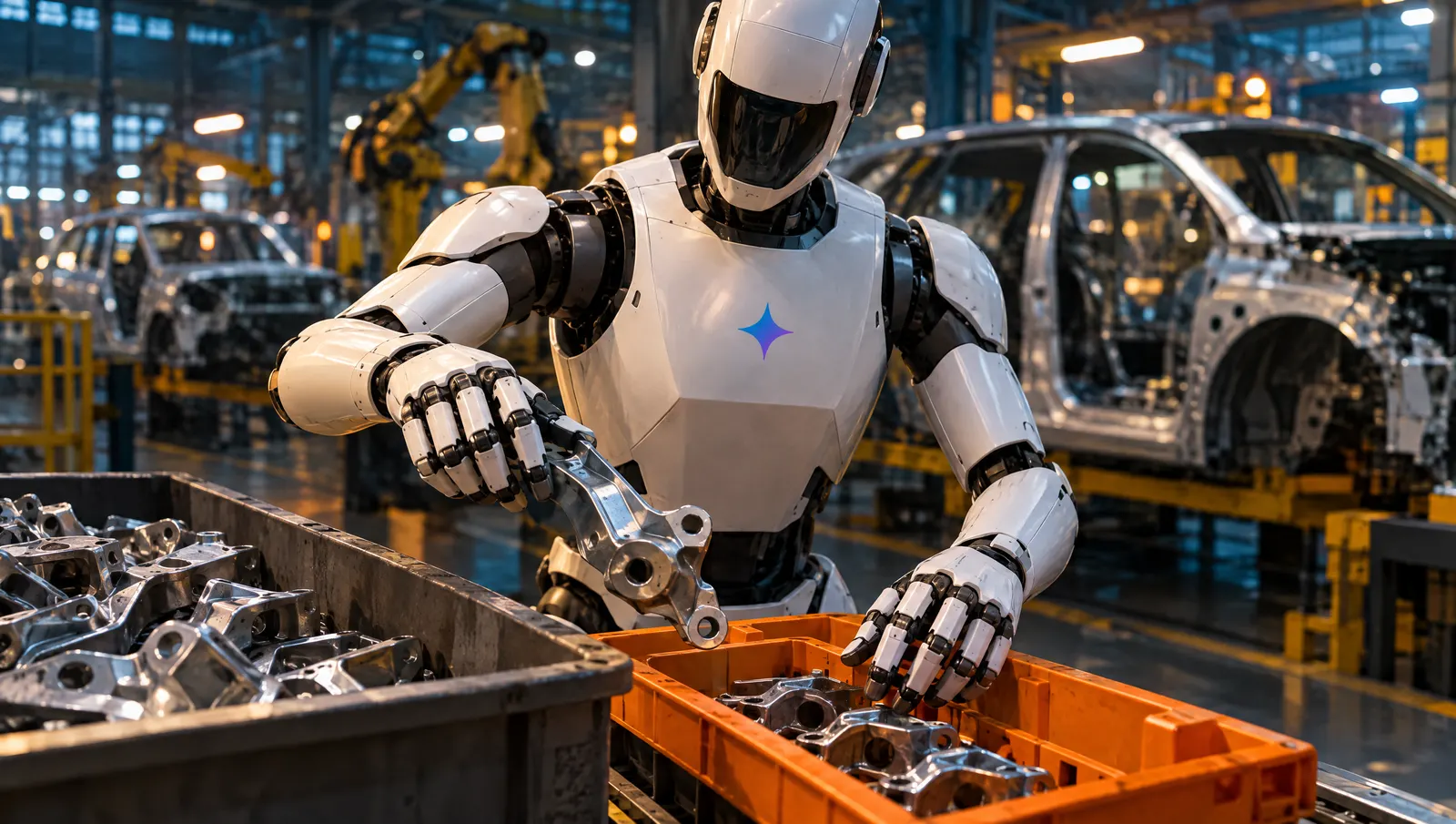

Google DeepMind has launched Gemini Robotics 2.5, its new AI model for robots. In a trial at two Mercedes-Benz plants, a humanoid robot picked and packed car parts with a 96 percent success rate, according to Google DeepMind. The model is now rolling out to the company's robotics partners.
The announcement came in a blog post and from Google DeepMind's official X account on Tuesday, 10 November, at 16:00 Oslo time. Gemini Robotics 2.5 is a vision-language-action (VLA) model: it interprets what the cameras see and instructions in plain language, and controls the robot's arms and hands directly. Google DeepMind calls it its most capable model of this kind to date.
A humanoid robot on the assembly line
The most concrete part of the announcement concerns car manufacturing. Together with robot maker Apptronik and Mercedes-Benz, Google DeepMind tested Apptronik's Apollo 2 humanoid robot on active production lines in Kecskemét, Hungary, and Sindelfingen, Germany.
The robot performed what is known as kitting: it picked metal brackets from bulk bins and placed them in sequencing containers in the exact order each vehicle on the line needs. It is repetitive, physically demanding work. According to Google DeepMind, the robot succeeded 96 percent of the time. The company calls this a proof of concept and does not say how long the test ran, how many parts were handled, or whether Mercedes-Benz will put the robots into permanent use.
Apptronik chief executive Jeff Cardenas says in the post that the models improved dramatically after a few weeks of post-training and carried over to Mercedes-Benz production with very little drop-off.
More skills, learned faster
Google DeepMind tested the model on more than 200 distinct tasks, including serving food with tongs, tying a bow on a gift box and pipetting liquid. Compared with previous baselines, the company reports a 30 to 100 percent higher success rate depending on the task type, with tasks completed 20 to 30 percent faster.
The model works with several robot types, including Apollo 2 with a five-finger hand and the Franka Duo platform with two-fingered grippers. According to the company, much of the progress is due to Gemini 4 Argon, one of Google's large Gemini models. Argon generates thousands of simulated practice runs and digital twins from a single camera view, and analyses video of the robot's mistakes to find improvements.
Safety around people
Google DeepMind writes that Gemini Robotics 2.5 uses reasoning at inference time to steer around physical hazards. In the company's own evaluations, safe task completion rose by 33 percent around obstacles and by 43 percent around nearby people.
The company is also releasing ASIMOV-Jailbreak, an open-source benchmark with hundreds of prompts that try to trick robots into unsafe actions. Gemini 4 Argon resisted 99.5 percent of them, compared with 82 percent for the previous baseline, Gemini Robotics ER 2. These figures are Google DeepMind's own and have not been independently verified.
The post says nothing about pricing, commercial terms or when anyone beyond the robotics partners will get access.
What it means for leaders
- Humanoid robots are getting closer to the production line. The Mercedes-Benz test shows that a general AI model can learn a specific factory task in a few weeks. Manufacturers with a lot of manual picking and packing should watch how quickly this moves from pilot to production.
- Software matters more than hardware. The same model controls robots from different makers. That could make it easier to switch robots, but it increases dependence on whoever supplies the AI model.
- Safety has to be documented. Robots working near employees require a risk assessment. Google DeepMind has published its own safety figures, but independent tests are still missing.
Sources and media
- Google DeepMind: Gemini Robotics 2.5 accelerates real-world general dexterity, 10 November 2026
- Google DeepMind on X, 10 November 2026
Illustration: AI-generated with Grok Bot / hogby.ai