Google launches TPU 8i Max and TPU 8tx: double chip power and encrypted AI
Google expands its eighth TPU generation with two systems: 8i Max doubles compute and memory bandwidth, 8tx keeps data encrypted during processing. No price or date given.
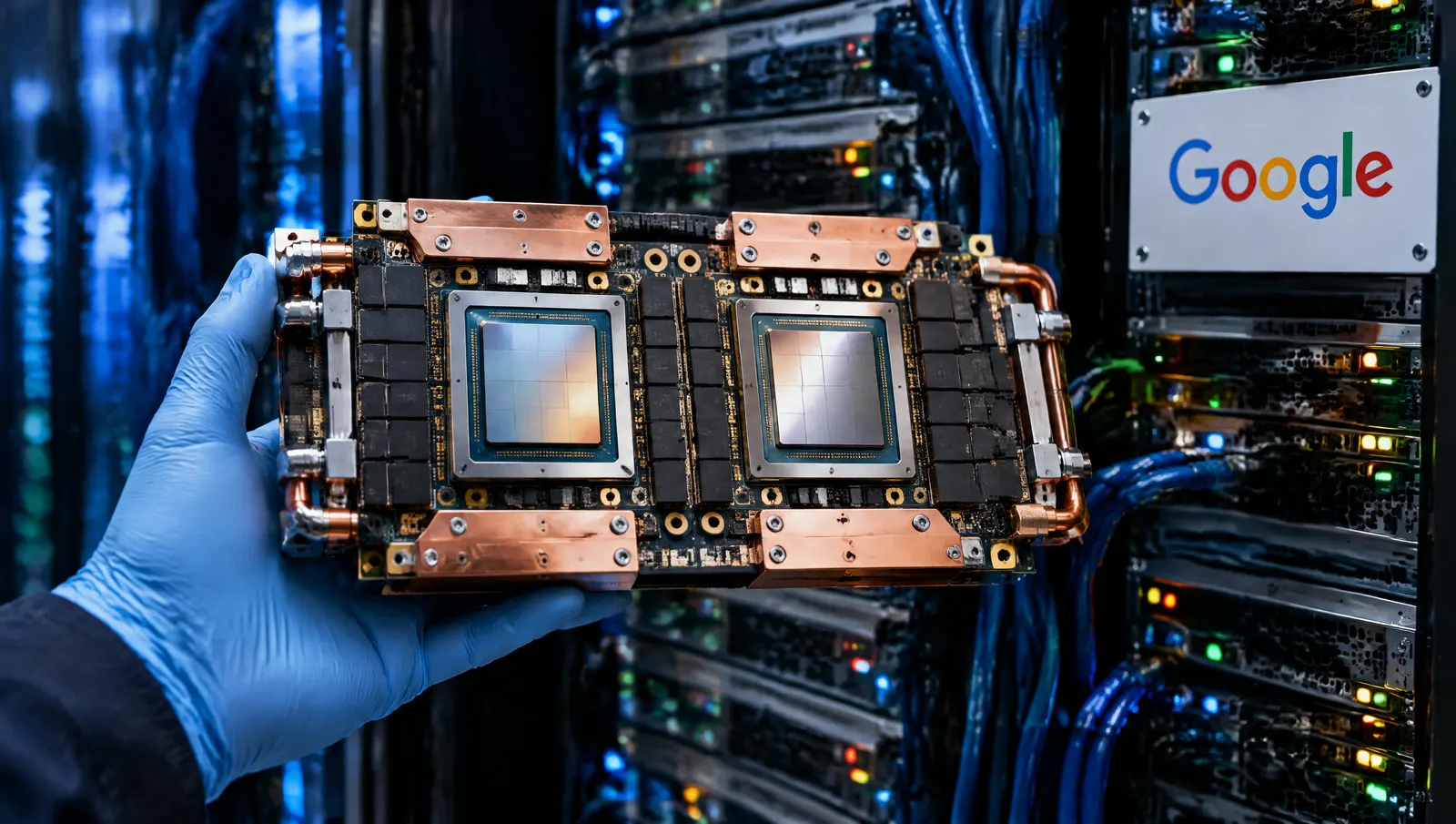

Google is launching two new systems in the eighth generation of its in-house AI chips: TPU 8i Max, which doubles compute and memory bandwidth per chip package, and TPU 8tx, which keeps data encrypted while it is being processed. That makes four TPU systems launched in a single year, and sharpens Google's competition with Nvidia for enterprise AI budgets.
Google announced the systems in a blog post on Monday, November 9, 2026, written by Amin Vahdat, Google's SVP and Chief Technologist for AI and Infrastructure. The company's official @Google account posted the announcement on X the same day at 13:43 UTC.
Two chips in one package
TPU 8i Max targets what Google calls the memory wall. When many AI agents work at once across an entire codebase or hours of video, memory bandwidth becomes the bottleneck. Google has therefore combined two TPU 8i chips onto a single package.
According to Google, that delivers double the compute, double the SRAM and double the HBM bandwidth of TPU 8i. The system fits twice the silicon within the existing rack footprint, which Google says lets data centers deploy significantly more compute per square foot and per watt. The company aims the system at massive context windows, meaning models that reason across millions of tokens.
Encrypted even while in use
TPU 8tx is built for regulated enterprises and governments running frontier or proprietary models alongside their most sensitive data. Data is normally encrypted when stored or sent over a network, but has to be unlocked in memory while it is processed. TPU 8tx builds security into the hardware layer, so that data and model weights, according to Google, stay protected and isolated even while in active use.
The system is built on the same silicon as TPU 8t and paired with 5th Generation AMD EPYC CPU hosts. Google claims up to 2x lower latency than TPU 8t with a near-zero performance penalty. Organizations are meant to be able to fine-tune models on private data, distill large models into smaller ones and train agents with reinforcement learning without moving sensitive data between separate clusters.
Four systems, one lineup
The new systems join TPU 8t for training and TPU 8i for real-time reasoning, which Google introduced at Cloud Next in April. Google said at the time that 8t offers up to 2.7 times better training performance and 8i 80 percent better inference price performance than the previous generation.
Google writes that TPUs are now a rapidly growing business with nearly 100 customers, including frontier labs, trading firms, retailers and universities. Customers can also deploy TPUs directly in their own data centers.
Google is also opening up the software around the chips. The company points to TorchTPU, open-sourced last month, which lets PyTorch code and Hugging Face models run natively on TPUs without rewrites. It is also launching an open-source TPU agent suite in preview that plugs into coding tools such as Claude Code, Cursor and Google Antigravity, and is open-sourcing TPU Sync. Cloud Pathways and GKE dynamic slicing are now generally available.
The blog post does not state pricing, an availability date or which cloud regions will offer TPU 8i Max and TPU 8tx. Nor does it say whether the systems will be available in Europe.
What it means for leaders
- Confidential AI becomes a hardware choice. For banks, healthcare and the public sector, which have kept sensitive data out of the cloud, encryption during processing is a concrete argument. Ask for documentation of how the isolation is built and audited before it goes into a risk assessment.
- Less lock-in to one chip vendor. When PyTorch code runs on TPUs without rewrites, Google becomes a more realistic alternative to Nvidia-based setups. That adds negotiating leverage, but you still need to test your own workloads.
- Ask for dates and regions. The announcement lacks pricing and availability. Before TPU 8tx or 8i Max goes into a plan, you need confirmation of when and where the systems can actually be rented.
Sources and media
- Google: Our newest TPUs: 8tx and 8i Max, built for the agentic era, November 9, 2026
- Google on X, November 9, 2026
Illustration: AI-generated with Grok Bot / hogby.ai