Mistral buys physics AI as Europe pushes AI into industry
Mistral is acquiring Austria-based Emmi AI to build models for physics, engineering and production workflows. For leaders, this is industrial governance, not another chatbot story.

Mistral AI is buying Austria-based Emmi AI for an undisclosed sum. At first glance, it looks like a small European acquisition. It is more than that.
Reuters reports that Mistral is using the deal to strengthen its offer for industrial clients across Europe. Emmi AI builds models for hard physics problems: airflow, heat transfer, material stress, digital twins and simulations that normally sit deep inside engineering teams. The company raised 15 million euros in 2025, according to Reuters.
The point is not that Mistral gets another technology component. The point is that European AI is moving from text, code and office productivity into production floors, R&D and machines where downtime is expensive immediately.
Mistral told Reuters that engineering and manufacturing are overlooked by much of the AI industry. Its approach is to assemble several AI tools around each customer’s process: one system may monitor production for defects, another may control a robotic arm, a third may process logistics data, while the full system operates in coordination. Emmi is meant to give that stack a better model of the physical world.
That is a more important AI direction than another chatbot launch.
Why it matters
For executives, this is relevant because industrial AI cannot be governed like an ordinary SaaS tool. When a model starts to affect production lines, maintenance, quality, inventory or R&D, accountability moves closer to operations, security and finance.
Three questions become practical, not theoretical:
- Which data can the model see?
- Which systems can it influence?
- Who is accountable if a recommendation causes downtime, faulty production or the wrong prioritisation?
There is also a European sovereignty angle. The European Commission has named manufacturing as an AI-critical sector, partly because Europe wants to reduce its dependence on US and Chinese technology. Mistral is trying to turn Europe’s industrial base into an advantage: advanced factories, materials expertise, automotive, energy, semiconductor equipment and defence.
Reuters points to ASML as one example. Mistral-equipped EUV lithography machines now use vision models to detect engraving defects. Diagnostics have been cut from hours to eight minutes, with the goal of reducing waste of expensive silicon wafers. ASML CFO Roger Dassen told shareholders in April that saving ten hours of downtime on such equipment has high value.
That is what boards and CIOs should notice. The value is not a model writing better emails. The value is fewer stoppages, faster troubleshooting, less material waste and shorter design cycles. But the risk moves closer to the core process at the same time.
From general model to production model
Most companies have so far assessed AI on three axes: price, performance and data security. Industrial AI adds a fourth: domain precision.
A general language model can be useful for explaining a drawing or summarising a manual. That is not the same as simulating heat, stress, airflow or failure modes in a machine park. Training data, validation, test regimes and human approval become decisive.
Mistral says, according to Reuters, that purpose-built models trained on company-provided data will outperform off-the-shelf alternatives in this work. That is a plausible claim, but also a demanding contract. The company must know which data goes in, how the model changes over time, what is logged, and how recommendations can be reproduced afterwards.
For industrial groups, energy companies, maritime suppliers and advanced manufacturers, the lesson is simple: do not buy industrial AI as a demo. Buy it as a controlled change to the operating model.
That means test environments before production. Clear limits on what the agent or model can do. Integration with existing quality systems. Logging. A path back to manual operation. Contracts that define who owns data, models, fine-tuning and errors.
Europe’s position
Mistral has long been treated as Europe’s main AI challenger. The Emmi acquisition shows where the company may have a more credible path than simply copying the US frontier-model race: specialised AI for industry, R&D and regulated operations.
It is less glamorous than consumer chat. It may also be more valuable if it works.
Executives should read this as a signal that the AI market is splitting. Some vendors will win the office surface. Others will try to win the production surface. The latter will require tighter governance, more domain accountability and closer cooperation between CIO, CISO, COO and technical teams.
Mistral-Emmi is therefore not just an acquisition notice. It is a sign of where the next round of enterprise AI may be decided: in engineering data, physical processes and systems where errors cost money immediately.
Sources and media
Primary source: Reuters, “Mistral AI buys Austrian physics AI startup in industrial push”, published May 19, 2026: https://www.reuters.com/business/autos-transportation/mistral-ai-buys-austrian-physics-ai-startup-industrial-push-2026-05-19/
Source credit: Reuters reported the acquisition, Emmi AI facts, Mistral’s industrial strategy, the ASML example and the Arthur Mensch / ASML context. Reuters’ Mistral logo image was not used or rehosted.
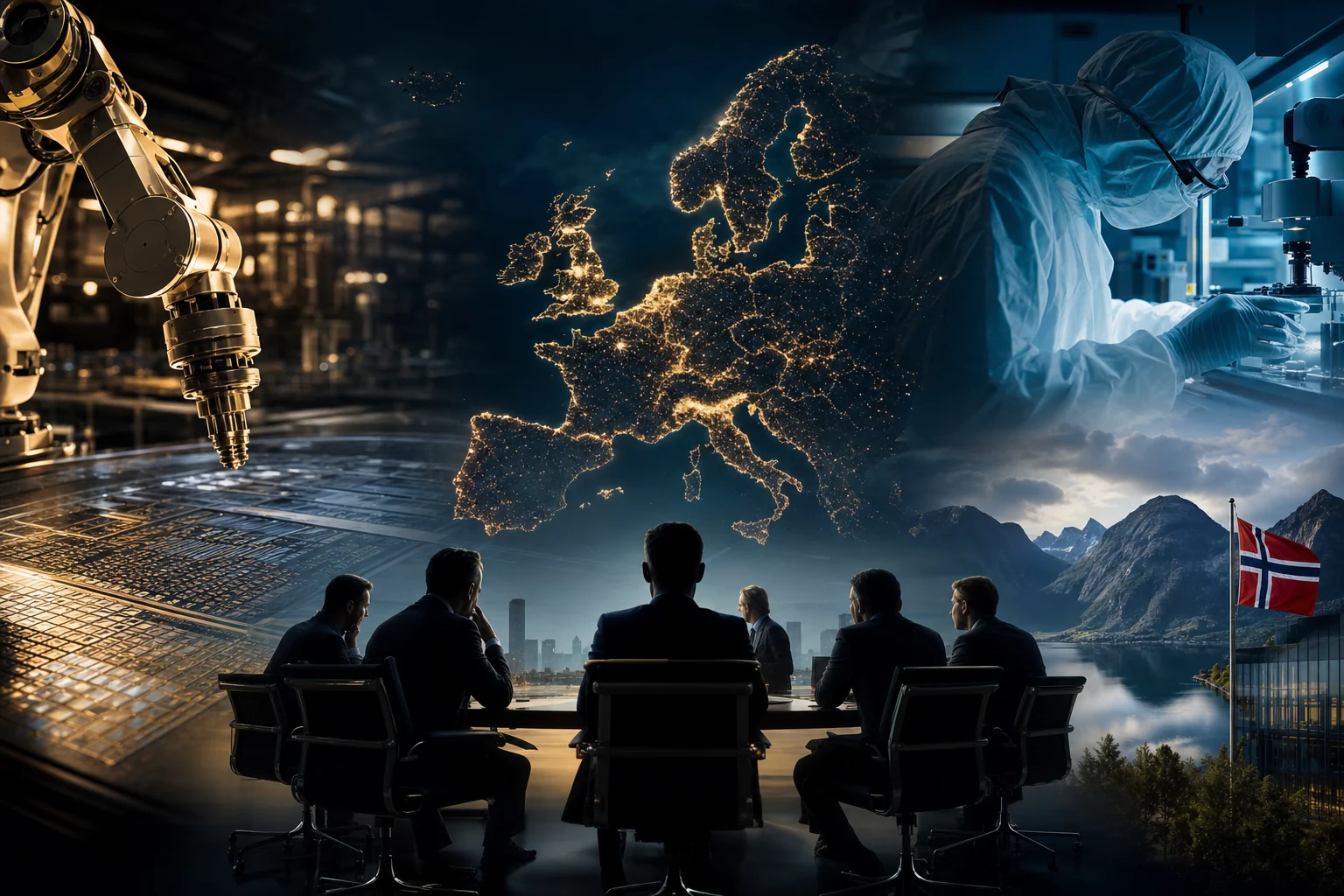
Thumbnail: OpenAI Image 2 / hogby.ai. Illustrative editorial visualisation of European industrial AI, physics simulation and production governance.