OpenAI beats Musk lawsuit as IPO path gets clearer
A jury found that Elon Musk sued OpenAI too late. For executives, the verdict is less about Musk drama and more about control, incentives and vendor risk as frontier AI providers become capital-market infrastructure.
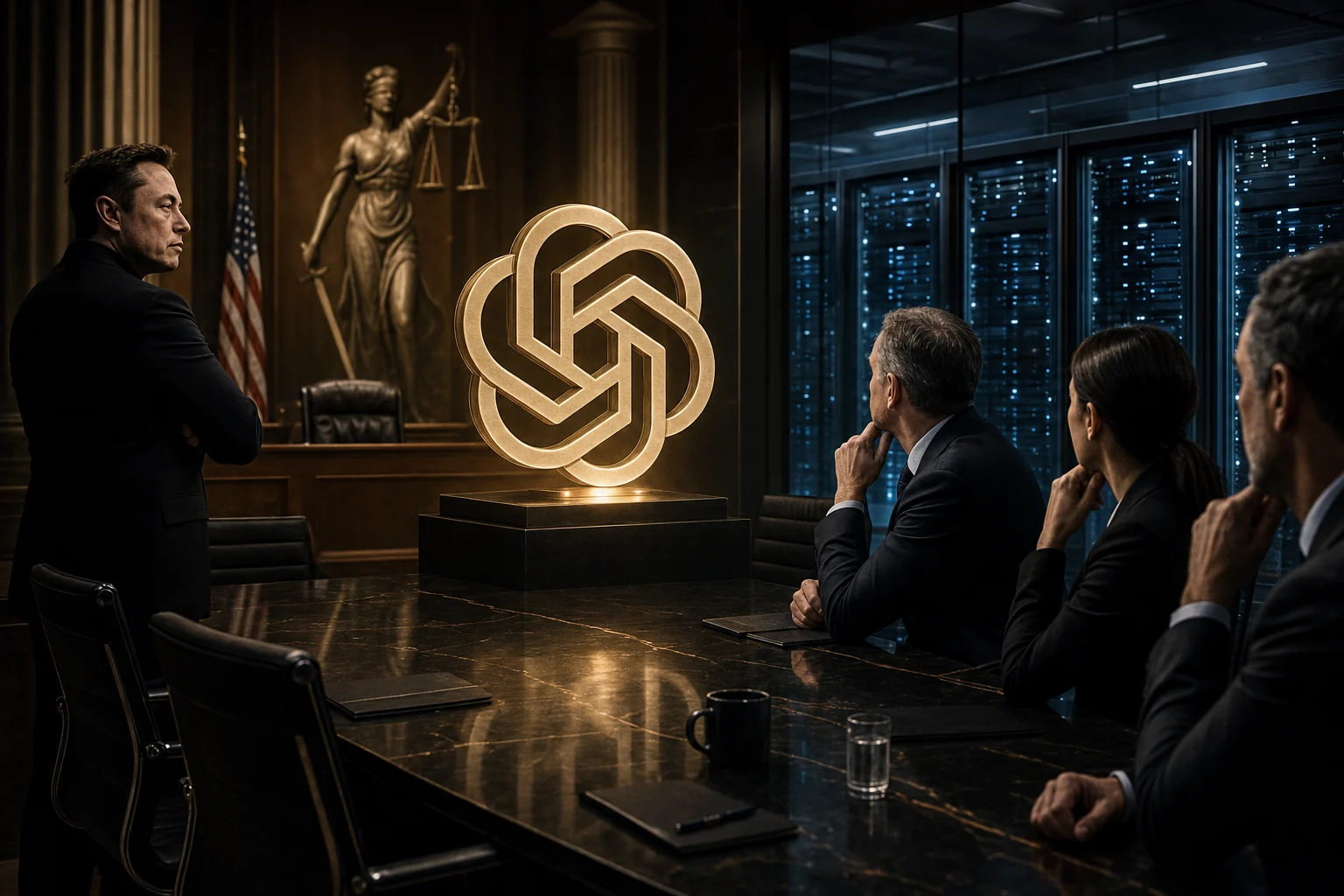

A U.S. jury has handed OpenAI a clear win in Elon Musk's lawsuit. Reuters reports that the jury in Oakland took less than two hours to find that Musk brought the case too late against OpenAI, Sam Altman, Greg Brockman and Microsoft.
It is easy to file this under Silicon Valley theatre. That would miss the point. For companies building operations on ChatGPT, Codex, GitHub Copilot or OpenAI models through partners, the verdict is also a governance signal. It removes a legal overhang on OpenAI's path toward a possible IPO and makes AI vendor control a board-level issue.
Reuters writes that the verdict simplifies OpenAI's route to a potential initial public offering that could value the business at $1 trillion. That number matters. It moves OpenAI from a product supplier to a form of critical digital infrastructure. When that kind of supplier becomes IPO-ready, the incentives change. Growth, margins, capital needs and partner deals become governance questions, not just technology choices.
What the jury decided
Musk argued that OpenAI had abandoned its original mission to build safe AI for the benefit of humanity. He also claimed that OpenAI attached a for-profit business to its original nonprofit structure, accepted large investments from Microsoft and others, and broke with the role he backed as an early investor.
The jury did not settle the entire moral argument about OpenAI's evolution. The decisive conclusion was narrower: Musk waited too long. According to Reuters, the jury found the case time-barred. Judge Yvonne Gonzalez Rogers said after the verdict that an appeal may face an uphill battle because the statute-of-limitations question was a factual issue already assessed by the jury.
Microsoft was also part of the case through an aiding-and-abetting claim. Reuters writes that a Microsoft executive testified that the company has spent more than $100 billion on its OpenAI partnership. Microsoft welcomed the jury's decision. Musk says he plans to appeal.
Why executives should care
The useful question is not who won the latest reputation round. The useful question is what happens when frontier AI providers are governed like capital-intensive platform companies. They need data centers, distribution, enterprise customers, partners, regulatory trust and, increasingly, access to public capital markets.
That creates three practical consequences.
First, AI vendor risk starts to look more like cloud risk than software risk. It is not enough to check model quality and price per token. CIOs, CFOs and procurement teams need to understand who controls the model, the infrastructure, the security promise, the terms of service and the roadmap. A lawsuit can disappear. Capital pressure remains.
Second, contracts should cover change of control, model access and data flows. If an AI provider goes public, changes ownership or moves functionality between partners, customers need to know what happens to data, logging, model versions, support and audit rights. This is especially important for finance, energy, health care, public-sector organisations and legal teams.
Third, boards need to own AI dependency. ChatGPT Enterprise, Codex and Copilot are often treated as tools. In practice, they are becoming work surfaces for code, documents, decision support, customer dialogue and internal knowledge. That means the vendor's governance model becomes part of the customer's own risk profile.
IPO-ready AI is not neutral AI
OpenAI has always had an unusual position: nonprofit origins, deep Microsoft capital and a commercial product that many enterprises already treat as critical infrastructure. The Musk case kept that tension visible. The verdict does not remove the tension. It makes it more market-driven.
The practical lesson is simple: build the AI portfolio as if the largest suppliers will change prices, packages, partnerships and governance faster than traditional software companies. Keep exit plans, data classification, clear approvals for agent use, independent logging and supplier terms that survive new owners or new IPO expectations.
Musk lost this round. OpenAI gained room to move. Customers should use the moment to tighten their own controls. Not because OpenAI is weaker after the verdict, but because it now looks even more like the type of supplier that becomes too important to buy on trust alone.
Sources and media
- Primary source: Reuters, "OpenAI defeats Elon Musk's lawsuit, removes obstacle to IPO", published May 18, 2026 at 17:35 UTC: https://www.reuters.com/legal/government/elon-musk-loses-lawsuit-against-openai-2026-05-18/
- Reuters credits Deepa Seetharaman, Jonathan Stempel and Greg Bensinger. Reuters trial imagery was used only as source/context material, not rehosted.
- Thumbnail: GPT/OpenAI Image 2 / hogby.ai.