Trump postpones AI order as model oversight stalls in Washington
The White House postponed an order that would have given agencies 90 days to test frontier AI models. Enterprises should not wait for regulators to move first.
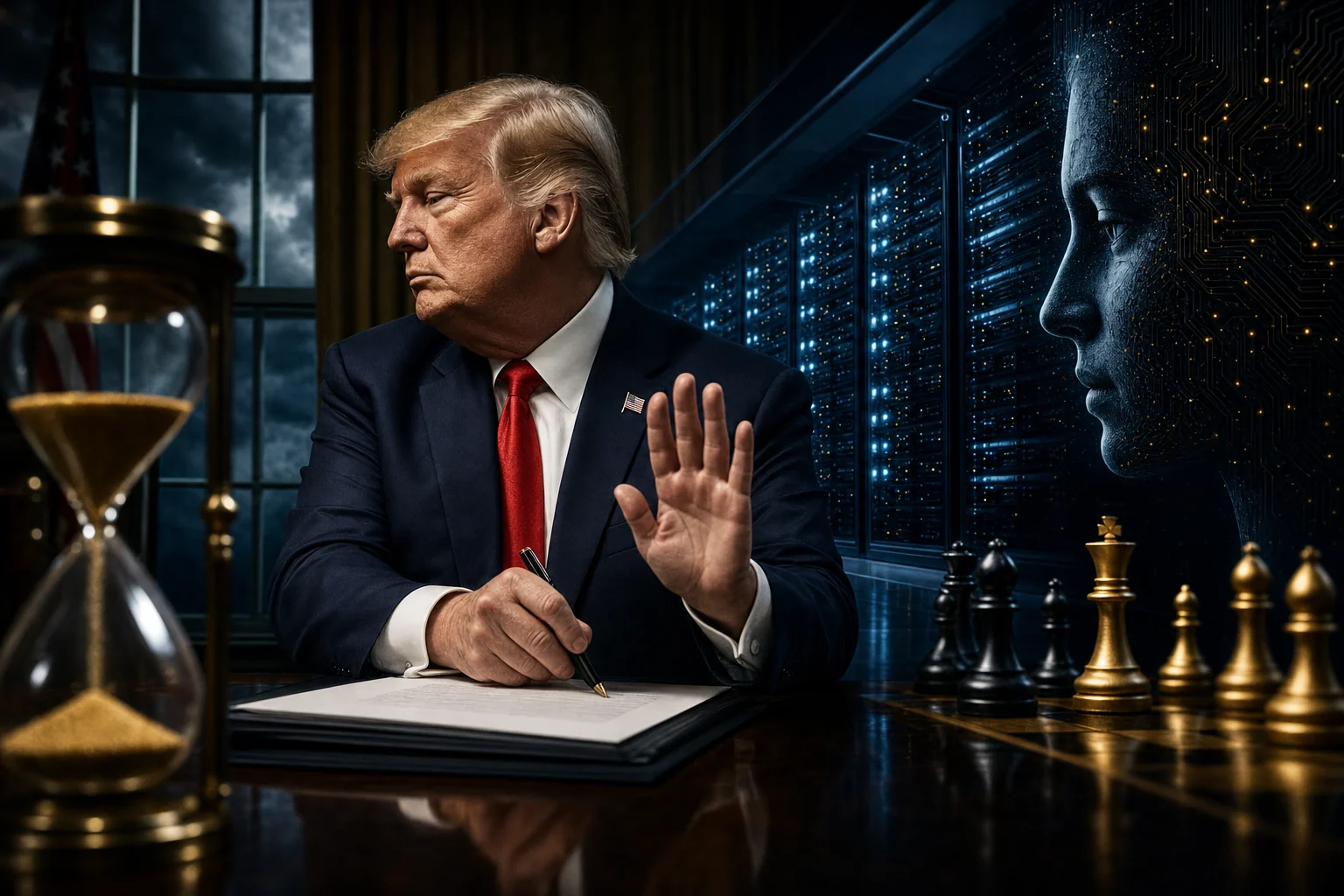

President Donald Trump has postponed an expected executive order that would have given U.S. agencies 90 days to test new frontier AI models before public release. CyberScoop reports that the order was ready for announcement, but was pulled back hours before signing.
This is not just a Washington process story. It shows how quickly AI governance is now being pulled between three competing demands: national security, commercial speed and the government's need for technical access before the most capable models are released.
Trump told reporters on Thursday that he postponed the order because he did not like parts of it and feared it could hurt U.S. competition with China. Politico also reports that tech executives had been invited to the signing and that some were already en route to Washington when the White House changed course.
What the draft order would have done
According to CyberScoop, the draft would have created a voluntary testing regime between federal agencies and frontier AI companies. The government would have been able to study new covered models for 90 days before public release. The access would not have been limited to the state. CyberScoop writes that the framework would also have supported cybersecurity testers in critical infrastructure sectors such as finance and healthcare.
The draft order gave the National Security Agency a role in classified evaluations of frontier models. The Department of the Treasury would have set up an information-sharing arrangement between AI companies and cybersecurity defenders in critical infrastructure. The Office of the National Cyber Director, CISA and NIST would also have helped define which models were covered.
The word voluntary matters. This was not a full licensing regime. But it would still have moved the U.S. from informal pre-release cooperation toward a more structured model for government access and testing.
Why executives outside the U.S. should care
The lesson for Norwegian and European organizations is simple: do not build AI risk management on the assumption that regulators will move first. Even in the U.S., where the government has deep technical security capacity, a concrete oversight framework ran into political friction before it could be signed.
CIOs and CISOs should treat frontier models as supplier risk, not just as software features. New models can increase productivity, but they can also expand code generation, vulnerability discovery, data access, decision support and automated action. When models are connected to internal tools, repositories, logs, case systems or customer data, reading a system card after release is not enough.
Contracts should require notice of material model changes, documentation of safety and security testing, the option to lock model versions, logging of agent actions and clear limits on how customer data may be used for training or evaluation. For critical workflows, organizations should run their own pre-release tests or at least controlled pilots before broad deployment.
From model evaluation to operational control
CyberScoop ties the order to concern over models that can find software vulnerabilities and chain them into more sophisticated attacks. The article points to newer models such as Anthropic's Mythos and OpenAI's Daybreak as examples of cyber capabilities that are forcing more serious evaluation.
That makes this an operating-model issue, not a narrow U.S. policy item. If a model can help a developer find flaws, it can also help an attacker do the same. If an agent gets access to code, internal documents, tickets or security logs, the organization needs to know who approved the access, what the agent did, which tools it used and how it can be stopped.
This is not an argument against AI. It is an argument against loose deployment. More capable models need more precise controls: role-based access, test environments, audit trails, human approval for irreversible actions and a clear rollback plan.
Washington hesitated. Enterprises should not.
Politico describes the delay as a sign of a divided U.S. AI strategy. On one side, officials worry that frontier models could create new cyber and national-security risks. On the other, the administration worries that oversight could slow American companies in the race with China.
That tension will reach Europe too, but in another form. The EU will ask for documentation, risk management and accountability. The U.S. will keep pushing for speed. Vendors will want faster deployment. Customers must capture value without absorbing unmanaged risk.
For boards, the practical conclusion is clear. AI decisions belong in the same governance track as other critical technology choices. The question is not only which model performs best. It is who can use it, which systems it can touch, what the vendor must disclose, and what control the organization has when the model changes.
If a U.S. 90-day testing framework can be halted hours before signing, waiting for public policy is not a plan. Enterprises need their own minimum requirements for model access, supplier governance and agent control now.
Sources and media
- Primary source: CyberScoop, "Trump postpones executive order focused on AI security", published May 21, 2026. https://cyberscoop.com/trump-postpones-executive-order-focused-on-ai-security/
- Time verification: Google News RSS registered the CyberScoop article on May 21, 2026 at 18:38 UTC; the CyberScoop page shows May 21, 2026.
- Corroboration: Politico, "Trump’s AI about-face", published May 21, 2026 at 23:34 CET. https://www.politico.eu/newsletter/forecast/trumps-ai-about-face/
- Photo/external media: CyberScoop uses an AFP/Getty image of Trump and Scott Bessent. Hogby.ai does not rehost that image.
- Thumbnail: OpenAI Image 2 / hogby.ai.