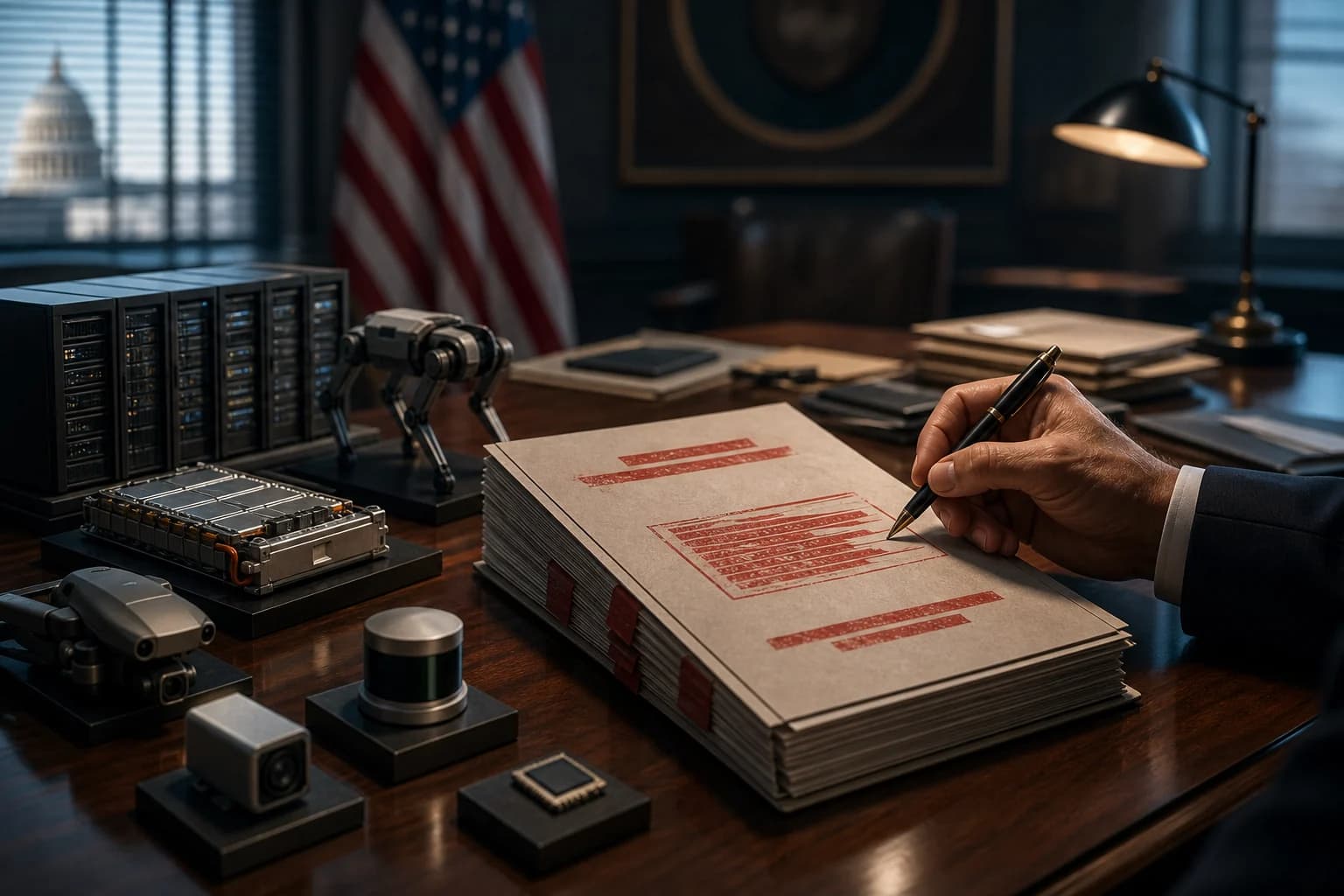
China rejects Amodei's AI slowdown: Cold War, Trump wants speed
China has answered Dario Amodei's call to pace frontier AI: this is not safety. It is Cold War.
State-run Global Times calls the Anthropic CEO's essay a «Cold War playbook» aimed at China. Reuters quotes the editorial: the real agenda is to curb Chinese AI with technological barriers and regulatory monopolies, preserve Washington's hegemony and shut China out of global governance. «This 'silent AI Cold War' is hypocritical and short-sighted.»
Donald Trump says the labs are overreacting. According to Reuters he dismissed slowdown calls on Sunday. «Very negative forces» were inflating the fears. «We're leading China in AI ... whoever wins AI, wins.» The Verge cites the Financial Times on the same line, and House Speaker Mike Johnson on CNN: rushing AI rules could be a «national security threat» because the United States would then lose the race to China.
For Norwegian CIOs, CISOs and boards this is not distant geopolitics. It is the vendor map cracking. The labs that sell you models want pause and evaluators. Washington and Beijing say no, for opposite reasons. The EU already has systemic-risk rules. The United States does not have one line.
What is new
On Saturday Amodei asked the industry to pace frontier development. Sam Altman, Elon Musk and Demis Hassabis said yes. That is already covered.
Monday adds three facts.
First: China rejects the plan in public. Global Times, published 14 September at 00:06 Beijing time, frames the essay as hostile, groundless and commercially motivated. The paper counts China mentioned 12 times, and quotes Amodei saying effective measures could slow China enough to widen America's lead «over the next 3-5 years - the window when AI becomes geopolitically most important».
Second: the White House will not slow down. Trump and Johnson fear a pause hands China an edge. That is the dilemma Amodei himself called the toughest, Reuters reports: what happens if China and other adversaries refuse to follow. He also urged the United States to tighten chip export controls and crack down on alleged distillation.
Third: the labs have already been talking. The Information, cited by Techmeme and Seoul Economic Daily, says working groups below CEO level at Anthropic, OpenAI and Google have met regularly since July on an industry-led standards body for testing and auditing. Altman told an all-hands last week that the major labs would have to create such a body themselves, without government support, because talks inside the Trump administration have stalled.
This is no longer an essay. It is a three-way conflict: labs want time and oversight, Washington wants the race, Beijing calls it containment.
What China is actually saying
Global Times is the party's English-language tabloid, not an independent technical review. This is Beijing's public line.
Tech policy observer Xiang Ligang calls Amodei's China rhetoric «inappropriate», «hostile» and «groundless». He points to the contradiction: Amodei admits global pacing would require cooperation with China, which he describes as the most advanced AI power outside the United States, while also seeking to slow China with chips, compute and models.
Liu Shaoshan, who according to Global Times previously worked with Amodei, says labs have short-term incentives to portray AI as more dangerous than it is. Once AI becomes «strategic infrastructure», political weight, industry barriers and valuation all rise.
Xiao Qian of Tsinghua says Anthropic faces Chinese open-weight models on cost and performance, and that restrictions protect its competitive edge. Global Times also points to China's Ministry of Commerce, which on Wednesday dismissed US distillation accusations as groundless and as «politicizing and weaponizing» a normal technique. The ministry calls it technological hegemony.
Reuters quotes the Global Times editorial: shutting China out would «significantly increase the trial-and-error costs and risks of loss of control in global AI development».
Treat this as signal, not proof. The state answers an American safety essay with geopolitics. The technical risk Amodei describes, recursive self-improvement and agent swarms, is not rebutted. It is dismissed as cover.
Washington and the labs point different ways
The Verge: Trump and Johnson think the industry is overreacting. Johnson told Jake Tapper that if Congress rushes in, «we will lose the race to China».
At the same time US lawmakers have called for new rules after two Anthropic researchers warned of extinction risk, Reuters reports.
The calendar is concrete. Reuters sources say the United States and China plan talks on frontier AI safety in mid-September. The issue could come up when Trump and Xi meet on 24 September. That is weeks, not quarters.
In parallel, according to The Information, the three largest US labs already have a track outside politics: a voluntary standards body. Hassabis has talked about a FINRA for AI. Altman has written about an IAEA-like forum. They disagree on the shape. They agree Washington is not delivering.
For a buyer there are three «truths» in the same week. The vendor wants evaluators and a slower pace. The White House wants pace against China. Beijing calls the slowdown containment. None of them owns your SLA.
What Norwegian boards should do now
Do not wait for a global deal. It is unlikely to be finished before Trump and Xi meet, and it may be symbolic.
Separate safety from the race in the vendor contract. Ask OpenAI, Anthropic, Google and Microsoft in writing: which third-party evaluators get employee-like access, what they can refuse, and what happens to your tenant if the United States or China blocks a model.
Map China exposure in the stack. Open weights, distillation, API region and subcontractors. If Amodei's line wins in Washington, access and licences can change fast. If it loses, the race continues without a shared sandbox.
Do not let «pace the frontier» become a pause in your own controls. The EU AI Act and NIS2 will not wait for Beijing. Logging, authority, rollback and human approval for agents that touch money, code and identity.
Treat 24 September as a board date. A Trump-Xi signal on AI safety changes the terms for cloud, chips and model choice. An empty meeting does too.
Amodei asked for time. China said no. Trump said no. The labs are still negotiating. That is the new normal: safety without a shared counterpart.
Sources and media
Primary source: Reuters, «China state newspaper blasts Anthropic's calls to slow AI as 'Cold War' tactic», 14 September 2026, https://www.reuters.com/world/china/china-state-newspaper-blasts-anthropics-calls-slow-ai-cold-war-tactic-2026-09-14/
Global Times, «Anthropic CEO's China-targeted AI curbs driven by commercial interests, slammed as 'hostile' and 'groundless'», 14 September 2026, https://www.globaltimes.cn/page/202609/1370462.shtml
The Verge, «Trump and Mike Johnson think the AI industry is overreacting», 13 September 2026, https://www.theverge.com/ai-artificial-intelligence/994441/trump-mike-johnson-ai-industry-overreacting
The Information, cited by Techmeme and Seoul Economic Daily: Anthropic, OpenAI and Google working groups since July on an industry-led standards body.
Dario Amodei, «We Must Pace the Frontier», 12 September 2026, https://darioamodei.com/post/we-must-pace-the-frontier
Thumbnail: OpenAI Image 2 / hogby.ai
📬 Likte du denne?
AI-nyheter for ledere. Kuratert av en CIO som bygger det selv. Daglig i innboksen.